News

CCWT Logo
News

Note from the Executive Director – December 2023

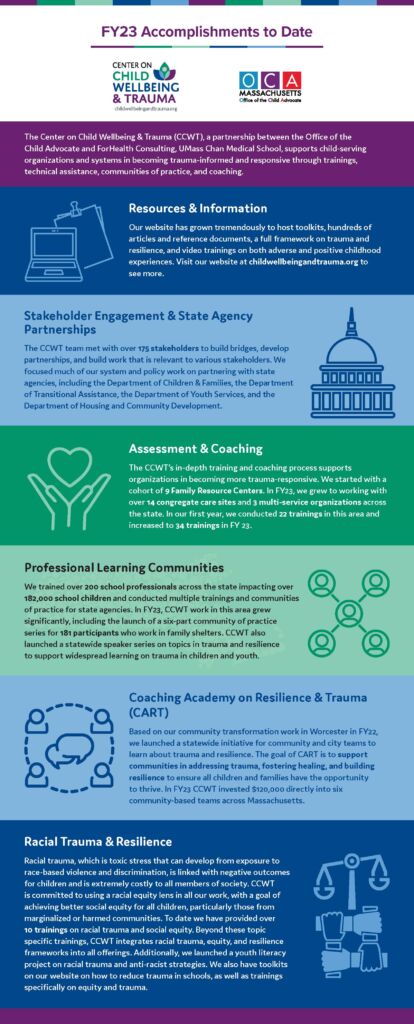
I speak for the whole team when I say we are happy to celebrate the Center entering its third year! The Center on Child Wellbeing and Trauma (CCWT) was established by the Massachusetts Legislature in 2021 following recommendations made by the Childhood Trauma Task Force and has continued to expand each fiscal year since. The CCWT supports child-serving organizations and systems in becoming trauma-informed and responsive through trainings, technical assistance, communities of practice, and coaching.

We have many accomplishments to share, and you can read about them in the CCWT FY23 Year in Review which highlights the successes of the Center over the last fiscal year. It has been a productive year, and the Center has reached thousands of providers including teachers, human service workers, staff agency staff, and provider organizations across the state.…

A multi-ethnic group of children standing in a row in a school hallway, excited and laughing, watching something. They are in kindergarten or preschool, carrying bookbags. They are 4 to 6 years old.
News

Speaker Series Features Range of Experts NEW

Join us to learn how Emily helps educators promote trauma-informed and responsive practices in their classrooms through her program, The Regulated Classroom, a framework that promotes felt safety and co-regulation for students, teachers, and staff. It was recently adopted by The New Hampshire Department of Education, providing 2,500 toolkits across the state. These tools can be applied across sectors and are useful to humans of any age.

VIDEO UNAVAILABLE…

A multigeneration family preparing freshly cooked food with each other. They are all wearing casual clothing and having a lovely afternoon.
News

Prevention in Partnership – Working Together to Prevent Maltreatment and Promote Family Wellbeing

Every few seconds, a report of child maltreatment is filed in the United States, and, on average, five children die from maltreatment every day (U.S. Department of Health & Human Services Administration for Children and Families). Child abuse and neglect are preventable: with the right supports, families can build the foundation they need for healthy, happy lives.

By working together, child-serving professionals, families, and communities can prevent child maltreatment and promote children’s safety and wellbeing.

Trauma-Informed and Responsive Principles to Prevent Maltreatment

To mark National Child Abuse Prevention Month, the Center on Child Wellbeing & Trauma wants to share how being trauma-informed and responsive (TIR) can help prevent maltreatment. Child-serving organizations and professionals can promote children’s safety and wellbeing by applying the five Guiding Principles of TIR care in their interactions with families.…

Cheerful female teacher talking with male colleague outdoors
News

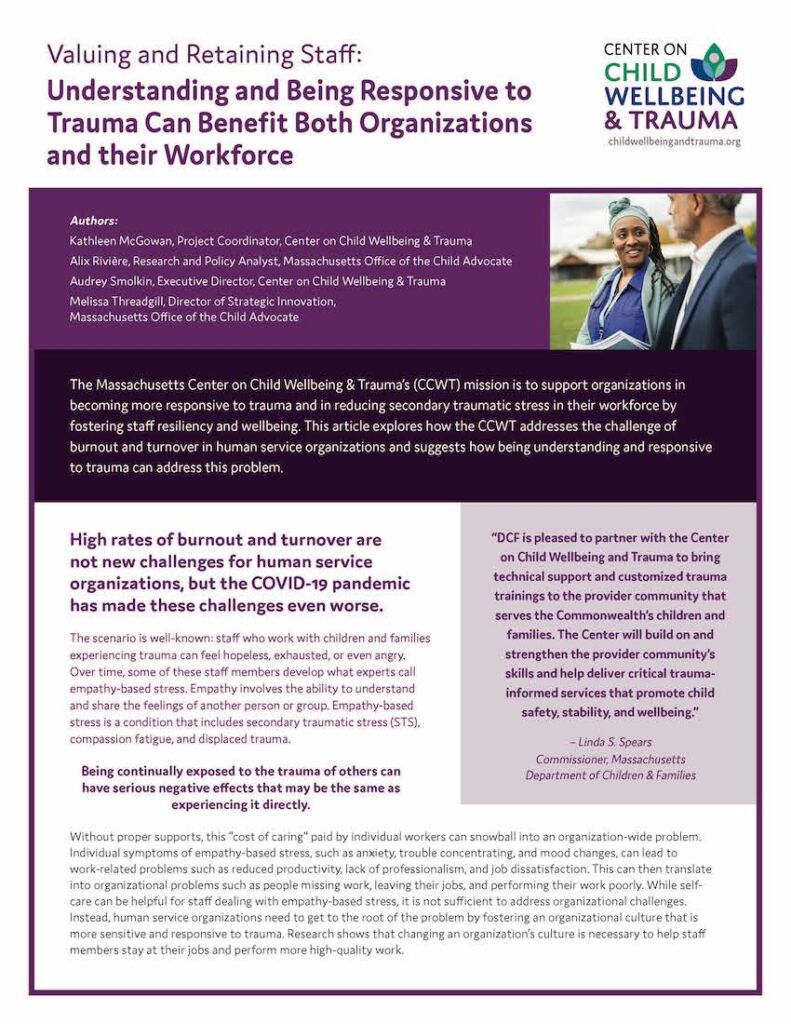
Valuing and Retaining Staff: Understanding and Being Responsive to Trauma Can Benefit Both Organizations and their Workforce

This issue brief explores how the Center on Child Wellbeing & Trauma addresses the challenge of burnout and turnover in human service organizations and suggests how being understanding and responsive to trauma can address this problem. It was co-authored by experts at the Center and the Massachusetts Office of the Child Advocate.

Valuing and Retaining Staff: Understanding and Being Responsive to Trauma Can Benefit Both Organizations and their Workforce Issue Brief

Click on image to download the issue brief

Kids having fun on the tobbogan hill
News

How Child-Serving Organizations Can Help Children (and Their Teams) Beat the Winter Blues

Daylight comes in small doses this time of year, and just as the light diminishes, so can our spirits. It’s called the winter blues, and child-serving professionals may notice that the blues aren’t fading as quickly as the sun in some children and teens who have or are experiencing trauma.

Seasonal affective disorder (i.e., SAD or “winter blues”) can heighten symptoms of depression and anxiety, impact sleep habits, and decrease energy levels, making it hard to focus and function throughout the day. And while SAD can affect all children, studies have found it disproportionately impacts adolescent girls.

For those experiencing the compounding effects of SAD, a walk to a supportive friend’s house, a breeze in summer, can now be treacherous, and the classrooms students spend hours in five days a week can appear even grimmer.…

Multiracial group of teachers walking in school hallway
News

Coaching and Professional Development Opportunities Expand for Districts and Schools

After a successful partnership between the Center on Child Wellbeing & Trauma and Thriving Minds during the 2021-22 academic year, the Center has expanded opportunities for Massachusetts schools and districts to learn about trauma-informed practices through coaching and learning cohorts and a professional development course. For CCWT’s second year partnering with Thriving Minds, 37 participants were selected from school districts and schools statewide.

Coaching Cohort for teams

Teams from districts or schools are paired with an experienced coach who meets with them at least monthly between January and June to guide their steps toward implementing trauma-informed practices and promoting change with buy-in from leadership.

Each team sets its objectives based on an action planning template that asks members to think through the components of a systemic approach to trauma-responsive practices (i.e.,…

Portrait of enthusiastic business people in circle
News

CART Charts Path in Developing Trauma-Responsive Community Initiatives

Six teams have been selected to learn about trauma and resilience to develop trauma-responsive community initiatives that promote safety, transparency, and trust; empowerment and choice; equity and cultural affirmation; and healthy relationships and interactions.

We are proud to introduce our 2023 CART cohort:

Handle With Care (HWC) Responders: North Central & North Quabbin Region

  • Team members: Renee Eldredge, Mike Ellis, Christine Holmes, Ally Law, Deputy Chief Nick Maroni, Carol-Lynne Papa, Chief Jason Tamulen
  • Initiative: Ensure first responders are trained in trauma-informed care to provide equitable services to youth and their families.

Bridge Builders: Pathways to Healing Through the Arts, Springfield

  • Team members: Melissa Burrage, Marie-Ange Delimon, Terri Haven, Mily Martinez, Shannon Mumblo, LaTonia Naylor, Naomi Naylor, Patience Naylor, Eleni Yalanis
  • Initiative: Support the Bridge Leaders and Sonido programs to provide additional layers of trauma-responsive support and value to the programs, helping participants feel respected, supported, empowered, educated, and embraced.
Playing with Snow Outside
News

Helping children who have or are experiencing trauma work through difficult emotions this holiday season

For many, the holiday season is a joyful one – the popular song “Have a Holly, Jolly Christmas” comes to mind – but for children who have or are experiencing trauma, Christmas, Hanukkah, Kwanzaa, New Year’s Eve, and other celebrations represent a season of emotional pain.

The barrage of festive sights, sounds, and smells meant to evoke magic and merriment can prompt anxiety, loneliness, and grief in children. And the social pressure and messaging focused on happy family time can be a source of distress for them, either because they may have lost one or more caregivers, or family members have caused them trauma.

Understanding how the holiday season can surface some of these emotions and integrating this knowledge in trauma-informed and responsive practices can help child-serving organizations and professionals support children and families for whom this time of the year evokes difficult memories and feelings.…

School Kids experimenting virtural reality
News

Trauma-informed and responsive care for children who have witnessed domestic violence

October is National Domestic Violence Awareness Month, a time to understand the prevalence of domestic violence in our communities and take action to reduce its harmful effects on victims, including children who are often witnesses to its ferocity.

On average, 20 people are physically abused by intimate partners every minute, according to the National Child Traumatic Stress Network, with millions of children exposed to domestic violence every year, no matter their family’s socio-economic status, nationality or religion. As witnesses, children can experience trauma that can negatively impact their emotional wellbeing, social and academic experiences and, potentially, the course of their lives.

The Center on Child Wellbeing & Trauma offers guidance to adults working with children and youth on how to offer trauma-informed and responsive (TIR) care in all aspects of their day-to-day practices, including helping professionals address the effects of domestic violence on children and families.…